
- Score sheets
- Tile and domino games
- Riichi Mahjong
How to score Riichi Mahjong
Riichi Mahjong scoring is a game of payments. Each winning hand is priced from its han and fu, and the losers pay it. Under EMA rules everyone starts with 30,000 points; after the South round, take off the 30,000, add the uma for your place, and the most points wins.
- 4 players
- Start with 30,000 (EMA)
- Ends after the South round
- Most points wins
Tabletales is free on iPhone and iPad.

This is the real Scorepad, live. Each hand is what a player won or paid, so every row adds to zero, and hand 9 is the uma. Tap any hand to change it.
Riichi Mahjong
Japan's form of mahjong, where each player starts with a stack of points, every winning hand is priced from its han and fu, and the losers pay the winner in point sticks until the South round ends.
Riichi Mahjong on BoardGameGeek.
How to play Riichi Mahjong, in brief
Four players start with equal points and trade them hand by hand. A winning hand needs four sets, a pair and a yaku, a named scoring pattern.
- DealEast, the dealer, takes 14 of the 136 tiles (no flowers or jokers), the others 13. A tile turned up marks the bonus tile, the dora.
- Draw and discardDraw a tile, discard one. Claim any discard with pon for three of a kind, or the left player’s with chii for a run of three.
- Win, or declare riichiCall tsumo on your own draw, or ron on a discard. With no claimed tiles and one tile to go, you can declare riichi, betting a point stick.
- East, then SouthA hand also ends if the wall runs out. The deal goes around the table once in the East round, then again in the South round, and the most points after that wins.
Price the hand, then the losers pay.
A hand can only win with at least one yaku. Its han (yaku plus dora) and its fu (minipoints) set the price from a printed table, and from 5 han up the fu stop mattering and a limit hand takes over. The dealer’s wins are worth half again as much. Who pays depends on how you won. Other styles of mahjong price a hand their own way: see which one your table plays.
What a winning hand pays
| Hand | Non-dealer / dealer |
|---|---|
| A non-dealer’s 3 han 30 fuSelf-drawn: 2,000 from the dealer and 1,000 from each of the others | 3,900 |
| Mangan, 5 hanThe 2025 EMA rules also round 4 han 30 fu and 3 han 60 fu up to mangan | 8,000 / 12,000 |
| Haneman, 6 or 7 han | 12,000 / 18,000 |
| Baiman, 8 to 10 han | 16,000 / 24,000 |
| Sanbaiman, 11 han or moreEMA; many other rules count 13 han or more as a yakuman | 24,000 / 36,000 |
| Yakuman | 32,000 / 48,000 |
| Riichi stickPaid when you declare riichi; the next winner collects it | 1,000 |
| Each counter (honba)Added to a win; on a self-draw, 100 from each player | 300 |
- Price the handCount the han and, under 5 han, the fu, rounded up to the next 10 (Seven Pairs is always 25 fu). Read the points off the table: a non-dealer’s 3 han 30 fu hand is 3,900.
- Ron: the discarder paysWin on someone’s discard and that player pays the whole price.
- Tsumo: everyone paysWhen a non-dealer draws their own winning tile, the dealer pays a double share and the others a single share, each rounded up to the next 100: that 3,900 hand is paid 2,000 + 1,000 + 1,000. When the dealer self-draws, all three pay the same.
- Play East, then SouthEach round is at least four hands, one per dealer. The game ends after the South round, when the first dealer would deal a third time.
- Settle with the umaTake the 30,000 start off every score, then add the uma by place: plus 15,000 for first, plus 5,000 second, minus 5,000 third, minus 15,000 fourth. The four results add to zero.
Hand 3: Mara draws her own winning tile.
It is East 3, and Dev is dealing. Mara completes a 3 han 30 fu hand from the wall, a tsumo, so all three of the others pay, and Dev, as dealer, pays the double share. This is hand 3 on the Scorepad above, where Mara’s win is typed the way it is paid.
| Player | Points won or paid | Hand |
|---|---|---|
| Mara | 3 han 30 fu, self-drawn2,000 + 1,000 + 1,000 | 4000 |
| Dev | Dealing this handThe double share | −2000 |
| You | Not dealingA single share | −1000 |
| Jonas | Not dealingA single share | −1000 |
The payments, kept straight.
Tabletales is a scorepad and scrapbook for game night. In Riichi Mahjong the players work out each hand’s han and fu at the table. Type every payment and the uma on the Scorepad, and it keeps the running totals.
- Every hand gets a rowKeep Highest wins and switch to By hand. Type each player’s gain or loss, so the TOTAL line is their change from the 30,000 start.
- Type it the way it is paidType each payment, or type a self-draw as its shares (2000 + 1000 + 1000) and Tabletales adds it up to 4,000. Keep full points (26200, not 26.2): the pad takes whole numbers only.
- The uma is one last handAfter the South round, add a hand with each player’s uma: 15000, 5000, minus 5000 and minus 15000. The trophy goes to the most points.
- And the night is keptSave it with who played and a photo of the table. Each game gets a history: how often you play it, who with, and who holds the high score.

- Everyone who was there
- Photos from the table
- Riichi Mahjong, with its scores
Common Riichi Mahjong scoring mistakes
- Paying the dealer like anyone elseThe dealer’s wins are worth half again as much (a mangan is 12,000, not 8,000), and on a non-dealer’s self-draw the dealer pays the double share.
- Rounding downFu round up to the next 10 and payments up to the next 100. A non-dealer’s 3 han 30 fu hand works out to 3,840 and is paid as 3,900.
- Winning on dora aloneDora only add han to a hand that already has a yaku. Without one, the hand cannot win.
- Adding the uma as you goThe uma is applied once, after the last hand, by final place.
Riichi Mahjong scoring, answered
- How does Riichi Mahjong scoring work?
- Each winning hand is priced from its han and fu using a scoring table, and the losers pay it: the discarder on a ron, all three others on a tsumo. After the last hand, EMA scoring takes off the 30,000 start and adds the uma by place.
- What are han and fu?
- Han are the doubles a hand earns from its yaku and dora, and fu are minipoints from its tiles and how it won, rounded up to the next 10. From 5 han up the fu no longer count, and the hand pays a limit such as a mangan.
- How many points is a mangan?
- 8,000 for a non-dealer and 12,000 for the dealer. A 5 han hand is a mangan, and the 2025 EMA rules round 4 han 30 fu and 3 han 60 fu up to one too.
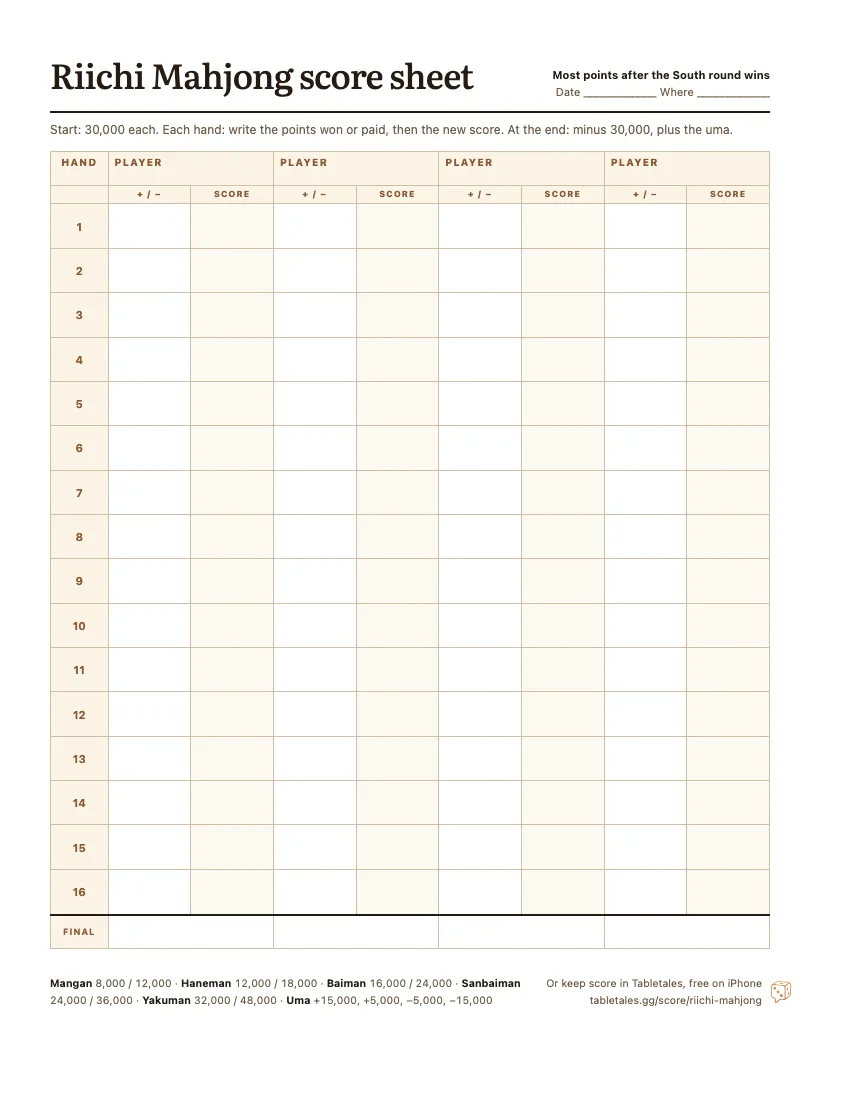
Riichi Mahjong score sheet
A printable Riichi Mahjong score sheet: four players and sixteen hands (room for repeats), with the points won or paid and the new score beside every hand, and the limit hands and uma at the bottom.
Score another game
This page follows the European Mahjong Association’s 2025 rules. Many Japanese rule sets start below 30,000 and give the difference (the oka) to first place, use other uma, or end the game when a player drops below zero, so agree on yours first. On an exhaustive draw, players who are not ready pay 3,000 in all to those who are. Under EMA rules tied players split the uma for their places; the Scorepad shows a tie, and the table settles the split. Rules checked on 19 October 2026 against the European Mahjong Association’s 2025 riichi rules, Wikipedia (scoring rules) and Wikipedia (Japanese mahjong).

Keep score tonight. Keep the night for good.
Tabletales adds up every hand, then saves the whole night: the games, the scores, the photos and who was there.