
Jaipur score sheet
A Jaipur score sheet keeps two things: the rupees in each round, and the seals. Add your goods tokens, your bonus tokens and the camel token; the richer trader takes a Seal of Excellence. Rupees never carry over, and the first player with 2 seals wins.
- 2 players
- About 30 minutes
- First to 2 seals
- Richer trader takes the round
Tabletales is free on iPhone and iPad.

This is the real Scorepad, live. Each row is a round: 1 for the Seal of Excellence, 0 for the other trader.
Jaipur
- BGG #204
- 30 min
A trading duel for two. You swap cards at a shared market, sell sets of goods for rupee tokens before your rival takes the best ones, and keep a herd of camels for the bonus. The richer trader in each round earns a Seal of Excellence.
Year, players, time and rank from BoardGameGeek.
How to play Jaipur, in brief
Jaipur is a trading duel for two: collect goods at a shared market and sell them for rupees. The richer trader in each round earns a seal.
- Set up the marketPut 3 camels face up between you, deal 5 cards each, and add 2 more to the market. Camels in your hand go into your herd.
- Take or sell, never bothTake one good, swap 2 or more of your cards for goods, or take every camel; the deck refills the market. Or sell cards of one good for tokens. Hold 7 cards at most.
- End the roundA round ends at once when 3 kinds of goods tokens run out or the market can’t be refilled. The richer trader takes a seal.
- Play to 2 sealsThe loser starts the next round, until someone holds 2 seals.
Sell early for the best tokens. Sell big for the bonus.
Every sale takes goods tokens off the top of that good’s pile, so whoever sells first gets the higher values. Bigger sales add a bonus token, and the camel token goes to the bigger herd when the round ends.
What a round is worth
| Token | Rupees |
|---|---|
| Goods tokensOne per card sold, from the top of that good’s pile | As printed |
| Bonus token for a 3-card sale | 1 to 3 |
| Bonus token for a 4-card sale | 4 to 6 |
| Bonus token for 5 or more cards | 8 to 10 |
| Camel tokenTo the bigger herd. Equal herds: nobody takes it | 5 |
- Sell for goods tokensTake one token per card sold. Diamonds, gold and silver sell only 2 or more cards at a time.
- Take the bonusA sale of 3 or more cards also takes a face-down bonus token, worth more for bigger sales.
- Count at the end of the roundThe bigger camel herd takes the camel token, 5 rupees. Then add up your goods, bonus and camel tokens.
- Award the sealThe richer trader takes a Seal of Excellence. On a tie, it goes to whoever has more bonus tokens, then more goods tokens.
- Start fresh, to 2 sealsRupees do not carry over. Set up a new round, which the loser starts, until someone holds 2 seals.
Round 3: a tie on rupees, and Mara takes the seal.
One seal each going in. Your big move was a sale of 5 cards; Mara’s bonuses came from a 3-card sale and a 4-card sale, and she kept the bigger camel herd. Both end on 56 rupees, so the tie goes to bonus tokens. This is hand 3 on the Scorepad above.
| Player | Rupees, then the tiebreak | Seal |
|---|---|---|
| You | Goods tokens 47 · a 5-card bonus worth 9 · the smaller herd56 rupees, 1 bonus token | 0 |
| Mara | Goods tokens 44 · bonuses worth 2 and 5 · the camel token, 556 rupees, 2 bonus tokens: the seal | 1 |
Tabletales keeps the seals. You count the rupees.
Tabletales is a scorepad and scrapbook for game night. In Jaipur you count the rupees at the table. In Tabletales you type who took each round’s seal, and it marks who reached 2 first.
- A row for every roundKeep Highest wins and switch to By hand. Each round is a hand: type 1 for the trader who took the seal and 0 for the other.
- Two seals end itPick Play to a score and type 2. The total that gets there turns gold, and the trophy goes to the player with more seals.
- Rupee ties are settled at the tableA tie on rupees goes to more bonus tokens, then more goods tokens. Type the 1 for whoever wins the round.
- And the night is keptSave it with a photo of the market. Jaipur gets a history: how often you two play it and who wins the most matches.

- Everyone who was there
- Photos from the table
- Jaipur, with its scores
Common Jaipur scoring mistakes
- Adding rupees across roundsEach round is counted on its own. The match goes to the first player with 2 seals, not the most rupees overall.
- Giving the camel token on equal herdsIf the herds are the same size, nobody takes the 5 rupees.
- Selling a single diamond, gold or silverThose three goods sell 2 or more cards at a time, even when only one token is left.
- Skipping the bonus when a pile runs shortA sale of 3 or more cards still takes its bonus token, even with fewer goods tokens than cards.
Jaipur scoring, answered
- How do you score Jaipur?
- At the end of each round, add up your goods tokens, your bonus tokens and the camel token if you have the bigger herd. The richer trader earns a Seal of Excellence.
- How do you win Jaipur?
- Be the first to win 2 Seals of Excellence, one per round. A match lasts 2 or 3 rounds, and rupees do not carry over from one round to the next.
- What happens if both players have the same rupees in Jaipur?
- The seal goes to the player with more bonus tokens. If that is tied too, it goes to the player with more goods tokens.
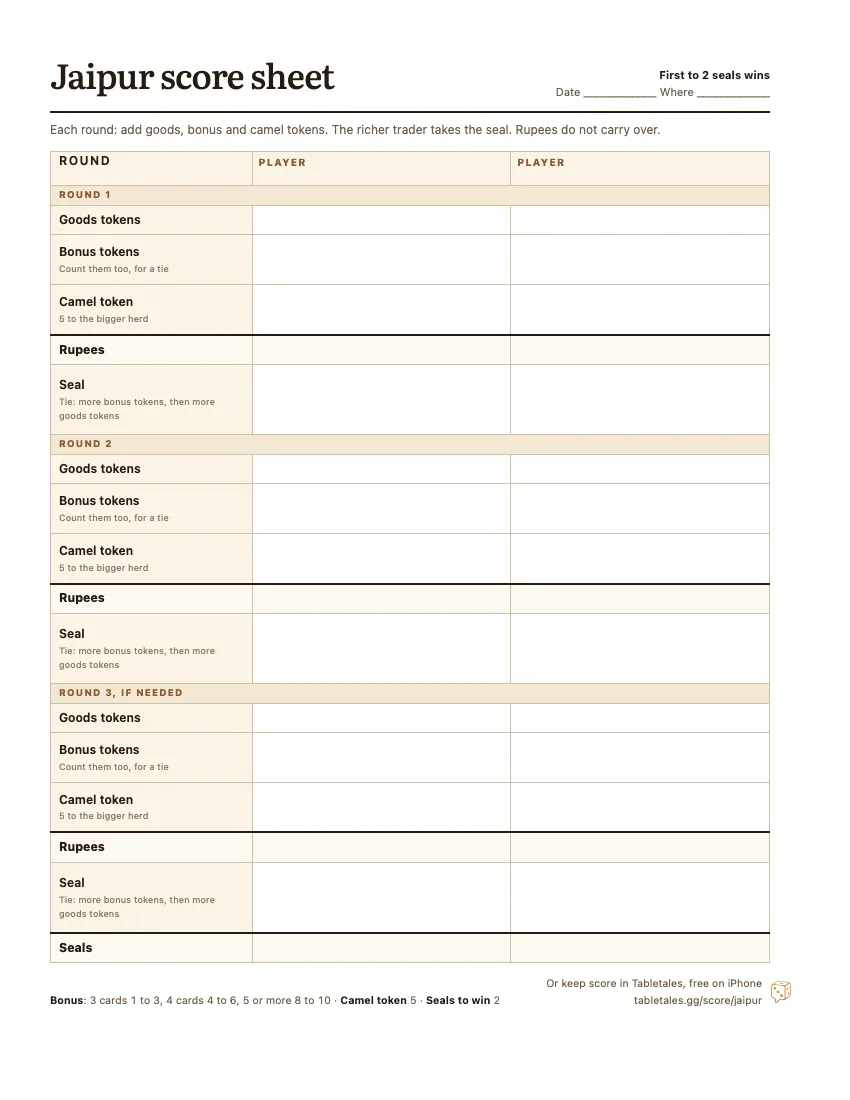
Jaipur score sheet
Print one for a match: both traders, three rounds, the tokens in each and the seal, with the tiebreak beside every round.
Score another game
Each goods token has its value printed on it, so this page counts goods as a total rather than token by token. The 2019 rulebook has no official variants, and the other sources match it. Rules checked on 19 October 2026 against the Space Cowboys rulebook, Yucata and UltraBoardGames. Jaipur is a trademark of Space Cowboys. Tabletales is not affiliated with Space Cowboys or Asmodee.

Keep score tonight. Keep the night for good.
Tabletales adds up every hand, then saves the whole night: the games, the scores, the photos and who was there.